
The Business
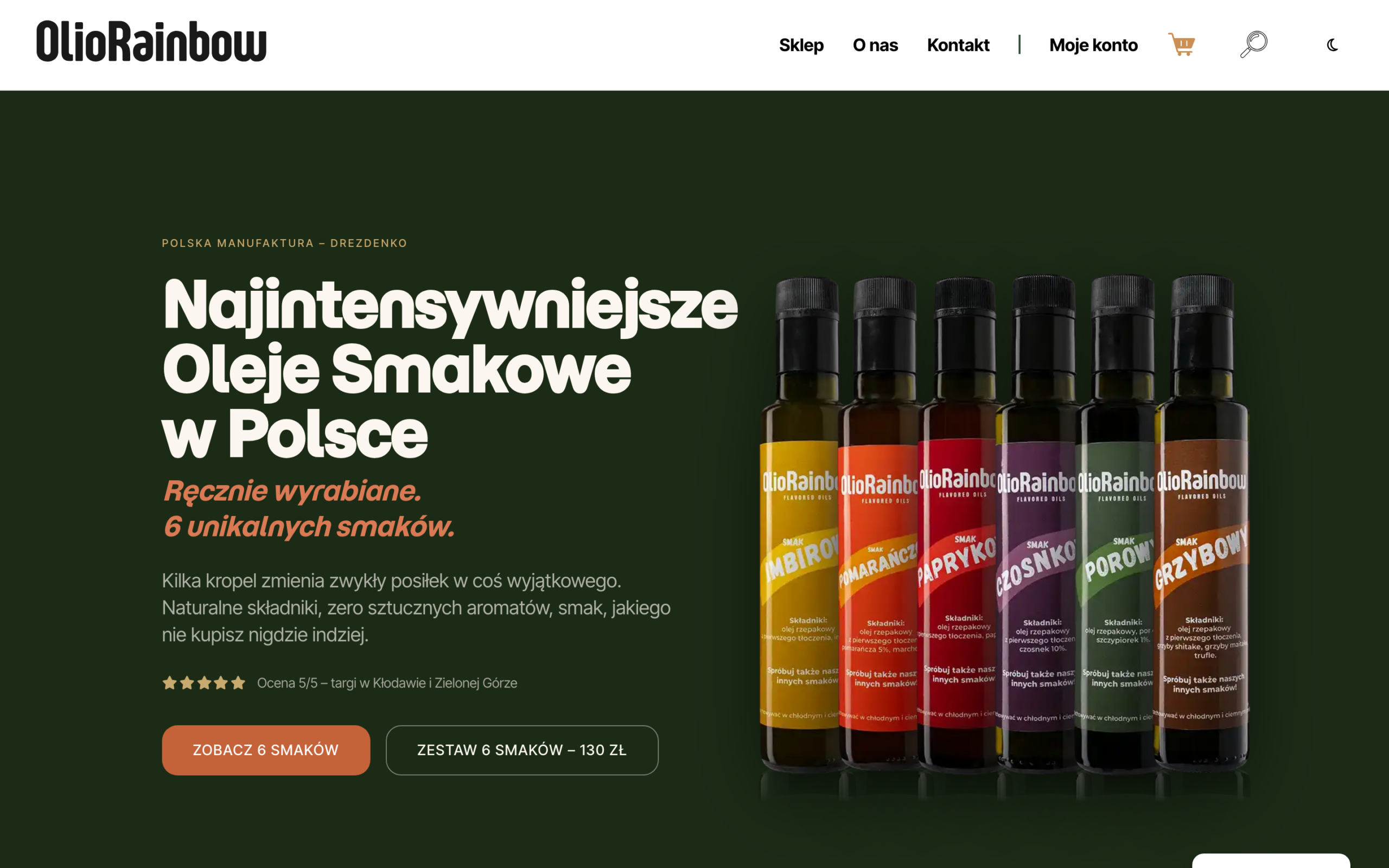
OlioRainbow is a small Polish brand making artisan flavoured rapeseed oils. Garlic, chilli, mushroom, ginger, orange, leek. Handmade in small batches, sold at farmers’ markets in Klodawa and Zielona Gora.
The founders launched their WooCommerce shop in late 2025. Products were there, payments worked, shipping was set up through InPost. The shop was technically functional.
The problem was that nobody could find it.
The Problem
When I ran the initial audit, the site had zero pages indexed in Google. Not low rankings. Zero. The site had been live for months and Google didn’t know it existed.
Here’s what I found:
Broken technical foundation. The robots.txt file was pointing to 22 non-existent sitemap URLs, all returning 404 errors. Google’s crawlers were trying to read a map that didn’t exist.
Thin product pages. Each product had roughly 180 words of content. A short description, a price, and a buy button. Not enough for Google to understand what the page was about.
Duplicate product structure. Instead of 6 products with size variants, the shop had 12 separate product pages. One for “Olej Porowy 100ml” and another for “Olej Porowy 250ml.” This split any potential SEO value across two weak pages instead of concentrating it on one strong one.
Wrong category logic. Products were categorised by bottle size instead of by flavour. Customers search for “olej porowy” (leek oil), not “100ml oils.”
No schema markup. No FAQ schema, no proper author attribution, no structured data beyond basic WooCommerce defaults.
Missing image SEO. 55 images with no descriptive alt text. Every image was a missed opportunity.
The result: roughly 5 organic search sessions per month and 45 active users total, mostly from direct visits.
What I Did
The work was structured as a 5-phase plan. I completed Phases 1-3 over approximately three weeks.
Phase 1: Technical Foundation
The first priority was making the site findable.
- Fixed the robots.txt to point to the correct sitemap
- Resubmitted the proper sitemap to Google Search Console
- Set up proper indexation tracking
This alone was the difference between “invisible” and “exists.” Everything else builds on top of this.
Phase 2: Product Page Transformation
Each of the 6 product pages was rewritten from roughly 180 words to 500-800 words using a structured template:
- Definition block explaining what the oil is and how it’s made (optimised for AI citation and featured snippets)
- Usage section with practical applications (cooking, dressings, marinades)
- Recipe cards in a 2×2 grid showing specific dishes
- FAQ section with 4-6 questions per product, each with FAQPage schema
The keyword research identified real search volume: “olej porowy” (leek oil) at 390 searches per month, “olej porowy przepis” (leek oil recipe) at 210 per month, and several long-tail terms around buying intent and usage.
Product Restructure
The 12 separate product pages were consolidated into 6 variable products with size options. I planned the restructure, created all 12 301 redirects, and verified every one worked. Categories were reorganised from bottle size to product type: “Oleje smakowe” (flavoured oils) and “Zestawy” (gift sets).
Phase 3: Homepage, About Page, and Site-Wide SEO
Homepage: Added FAQPage schema with 7 questions, fixed meta description, corrected H1, fixed author attribution.
About page: Full rewrite at 433 words with 5 structured headings and 10 internal links to products and the shop. Changed authorship from a generic admin name to the real founder (important for E-E-A-T: Experience, Expertise, Authoritativeness, Trust).
Site-wide fixes:
- Meta descriptions for every page and product (150-160 characters each)
- Alt text on all 55 images
- Author attribution corrected across 24 pages and products
- Internal linking strategy connecting products, categories, and informational pages
What I Delivered
- Full SEO audit (40+ checkpoints, scored)
- Keyword research based on real Polish search data
- Site architecture restructure plan (5 phases)
- Product marketing context document
- Content strategy with editorial calendar
- 6 product page rewrites (3-4x content expansion)
- About page rewrite with internal linking
- FAQPage schema on 7 pages
- 12 URL redirects (301)
- 55 image alt texts
- Meta descriptions for all pages
- Technical fixes (robots.txt, sitemap, Google Search Console)
The Numbers
Before
- 0 pages indexed in Google
- ~5 organic search sessions/month
- ~45 active users/month (mostly direct)
- Product pages averaging 180 words
- 0 pages with FAQ schema
- Near-zero image alt text coverage
After
- Clean sitemap with 11 structured URLs
- All pages submitted and indexable
- Product pages at 500-800 words (3-4x increase)
- FAQ schema on 7 pages
- 100% image alt text coverage
- 12 working 301 redirects
Why This Matters
This is the kind of problem that’s invisible until someone looks for it. The shop was “live.” Customers could buy things. The founders probably assumed Google would find them eventually.
But Google doesn’t find you automatically. Your site needs a clean technical foundation, content that answers what people are searching for, and structured data that helps search engines understand what you’re selling.
For a small food brand competing against established players in a niche market, SEO is the difference between relying entirely on market stalls and having a 24/7 sales channel that grows over time.
The work I did for OlioRainbow is the same approach I apply to any small business site: fix the technical foundation first, then build content that earns rankings, then maintain and expand.
Is your website live but invisible to Google?
Book a free strategy call and I’ll tell you what’s holding it back.